
There is an old promise at the heart of every proper mystery: that the reader could solve it. Not that they will, but that they could, if only they were clever enough. That promise has a name. We call it fair play, and I would not write a mystery without it.
The Reader's Contract
The writers of the Golden Age, Agatha Christie and Dorothy L. Sayers chief among them, took this promise so seriously that they wrote it into rules. No clue may be hidden from the reader. No unknown poison, no secret passage sprung in the last chapter, no twin nobody mentioned. The detective may not conceal a single thing she notices. The pleasure of such a story is the pleasure of a game played honestly, and when the solution finally lands you want the reader to gasp, and then, half a breath later, to groan, because it was sitting there in plain sight the whole time.
The cozy makes that contract warmer but no less strict. The stakes stay gentle, the violence happens politely offstage, the tea is plentiful. The puzzle, though, must still be solvable from the page. A cozy that cheats is simply a cheat in a prettier bonnet.
The Problem With a Sleuth Who Sees Ghosts
Here is my particular difficulty. My sleuth, Henrietta Crewe, can see the dead. A reasonable skeptic might fold their arms and say: well, that is cheating outright. The murdered party is standing right there in the parlor. Why does Hetty not simply ask the victim who did it and be home in time for supper?
Because the dead of Wexcombe are bound by rules every bit as strict as Christie's. A ghost cannot name its own killer, nor recall the moment of its death. A spirit is tethered to a single place and cannot go drifting about town gathering clues. And, most useful of all to a novelist, a ghost is only as honest as it was in life. A kind soul tries to help and gets everything muddled; a scoundrel lies to you from beyond the grave with tremendous enthusiasm and not a flicker of shame.
So the gift never hands Hetty the answer. It points, it pressures, it unsettles her at dinner parties, and when the ghost is feeling spiteful it sends her marching off in entirely the wrong direction. Whatever it whispers, she must still prove the ordinary way, with evidence the reader has seen for themselves.
Why the Rule Makes the Puzzle Better
Constraints are a gift to a writer. A magic that solves everything is a very dull magic; a magic that complicates everything is a plot engine that never stops running. Hetty's gift turns the paranormal from a shortcut into a fresh sort of clue, an unreliable witness who happens to be dead. The reader gets to weigh that testimony exactly as she does, and a careful reader learns, just as Hetty has, precisely when not to believe a word of it.
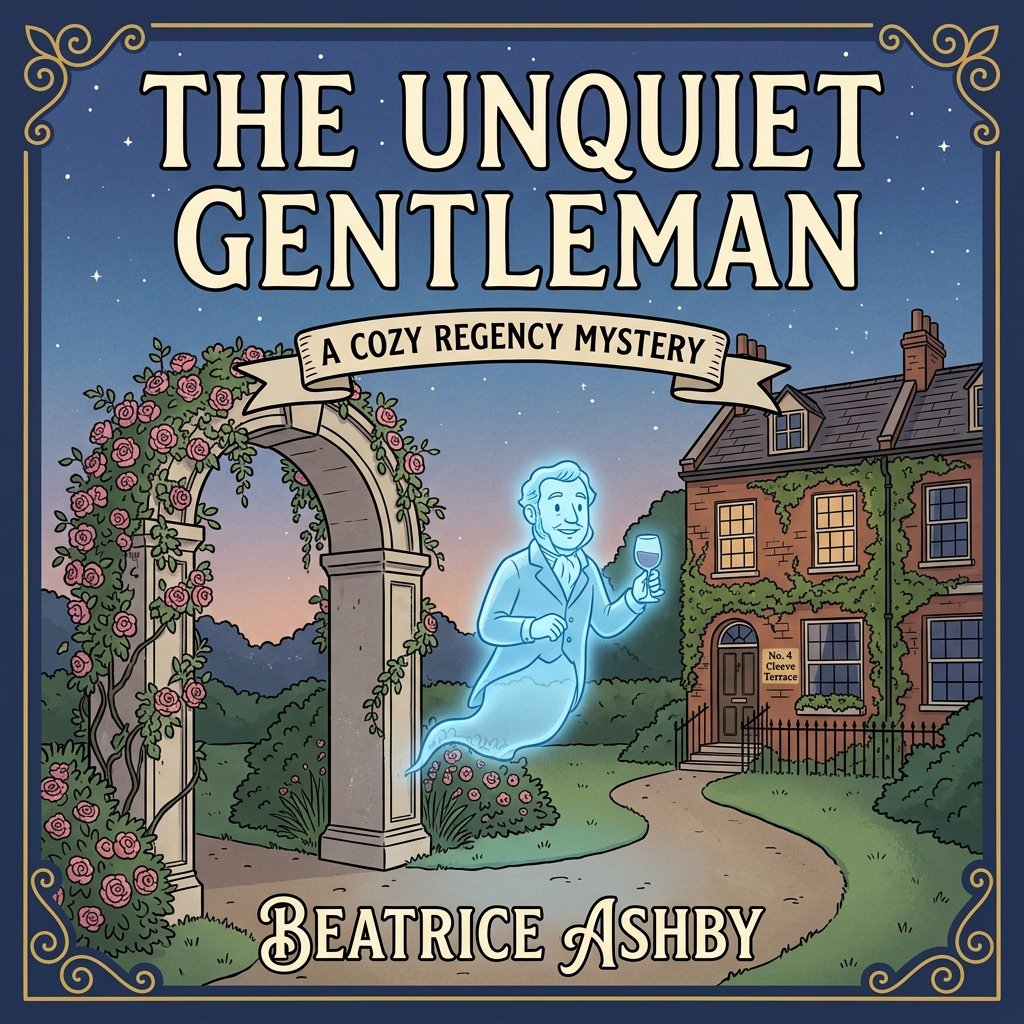
As for Sir Crispin, my resident Restoration ghost, he will tell you he is an enormous help. He is not. He is an enormous distraction with strong opinions about wine. But that is fair too: every unhelpful thing he says is right there on the page for you to take or leave.
Fair play sounds like a restriction. It is really a courtesy, the author leaning across the desk to promise the reader: I have not lied to you. The answer is in your hands. So pour the tea, and watch the quiet ones, and the cordial nobody else thought twice about. You can solve this. I rather hope you don't, on the first read. But you could.