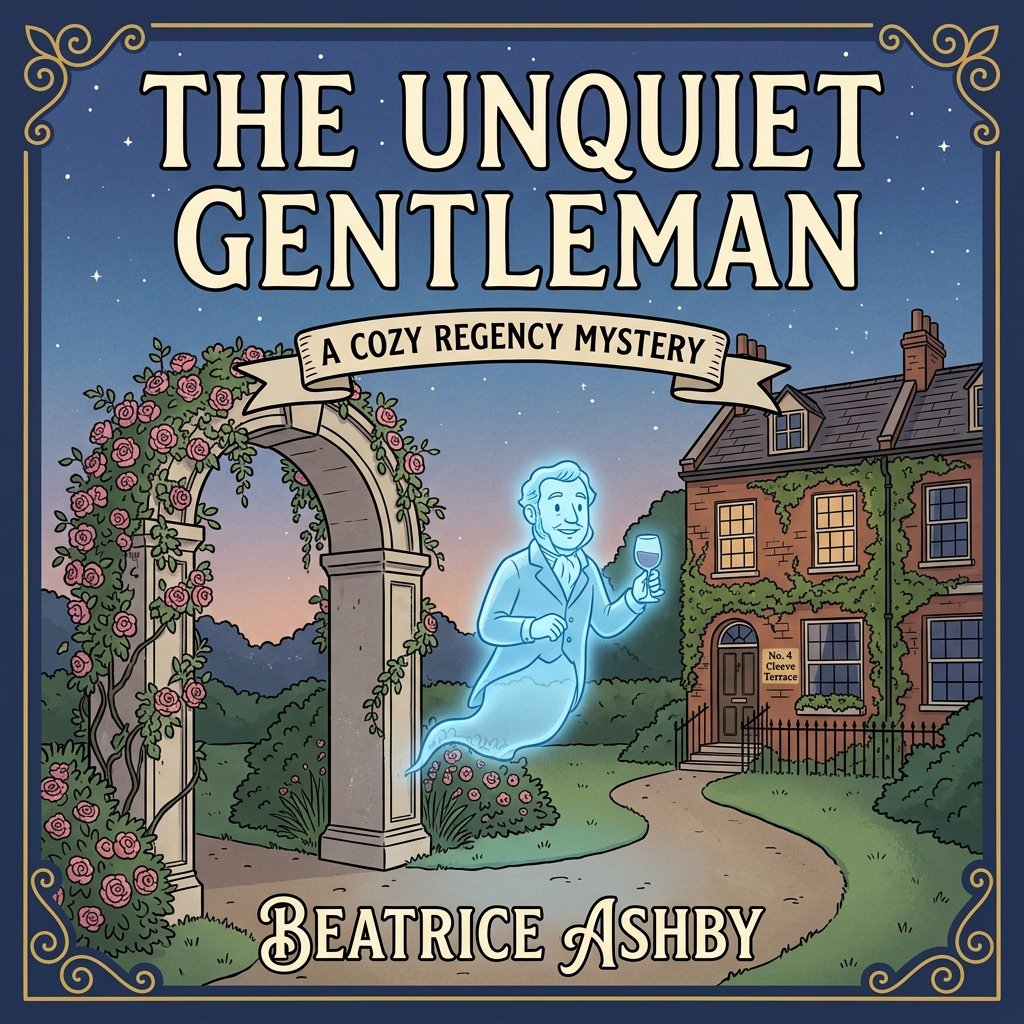

Sir Crispin Fanshawe has been dead for one hundred and forty years and has no intention of being useful about it. Here, we look at the choices behind writing a Restoration ghost who is all wit, no answers.
When I first sat down to write the world of Wexcombe, I knew I wanted a ghost who was a permanent resident. Most paranormal cozy mysteries feature ghosts who are eager to solve their own murders so they can move on. That is a fine structure, and indeed, it is the primary motor for each book's standalone mystery in the Elegant Specter Mysteries. The victim of the week always wants Hetty to find their killer.
But Sir Crispin is different. He is our anchor, bound to the hearthrug of No. 4 Cleeve Terrace since 1680. He represents the overarching meta-mystery of the series, but he also represents something else: the tragedy of a life cut short, masked by a century and a half of practiced cynicism and Restoration-era theatrical flair.
A Clash of Eras
One of the greatest joys in writing Sir Crispin is the sheer comedic friction between his Restoration sensibilities and Hetty's respectable Regency world. Crispin died during the reign of Charles II, a time of grand excess, bawdy comedies, and theatrical gestures. Hetty, on the other hand, lives in the early 1800s, where manners, decorum, and appearances are everything.
To Crispin, Hetty's worries about propriety, chaperone rules, and whether a gentleman magistrate looks at her too long are endlessly amusing. He is constantly advising her to throw decorum to the wind, usually with a glass of phantom sherry in hand. His advice is rarely helpful for solving a murder, but it is precisely the comic relief Hetty needs to maintain her sanity when dealing with the gruesome details of a crime.
The Tragedy Beneath the Rake
Yet, as the series progresses, the comic mask begins to slip. Sir Crispin is bound to one house. He cannot leave. He cannot touch the books he wishes to read or drink the wine he remembers. He is a spectator to a world that has moved on without him, surrounded by descendants of families he once knew.
Writing a character who uses humor to deflect deep, historical grief is a delicate balancing act. When Hetty recovers a specific locket in Book Three, we see the first real crack in Crispin's armor. For the first time, he doesn't deflect. We see the lonely man who has watched families bloom and fade from his parlor rug, waiting for a justice that has been denied him for a century.
He is unhelpful because he does not know the answers to the present-day crimes, and he has long since given up on solving his own. But in standing in the gap for him, Hetty finds her purpose, and Crispin finds, at last, a friend who sees him for who he truly is.